
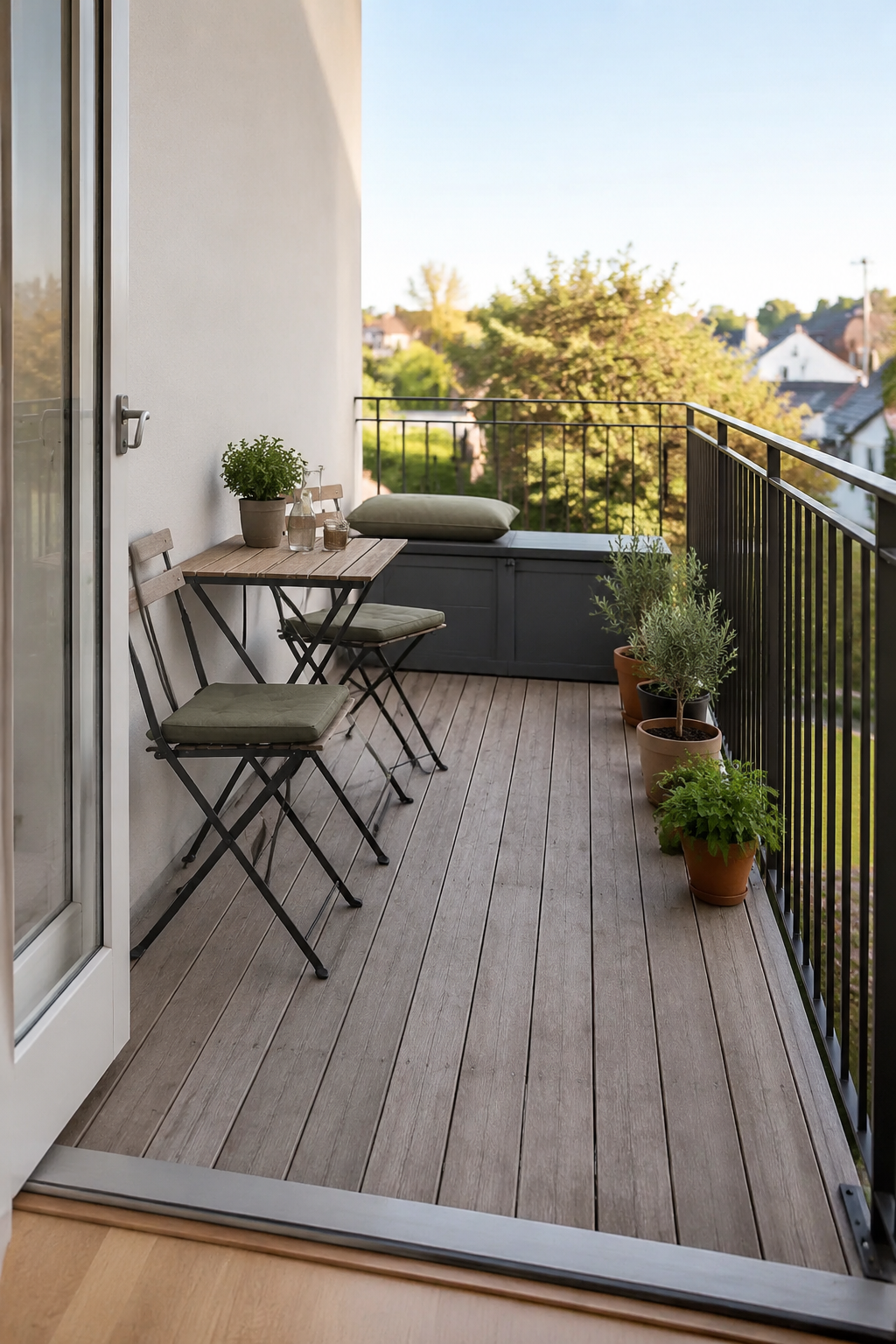
On a small patio or balcony, empty floor is not wasted space. It allows the door to open, a chair to move, a person to pass and the whole setup to be reset before bad weather. Build a floor-space budget around those actions, then ask every object to justify the area it occupies in use and in storage.
Protect the route before drawing the room
Measure the surface at its narrowest points and record the door, threshold, drains, outlets, railings, walls, downspouts and anything that projects into the usable area. Photograph the patio from inside the room: the first view matters, but the doorway must work before the scene looks composed.
Mark the door movement and habitual walking route with low-tack tape. Then walk it carrying the things that actually travel outside—a tray, watering can, laptop or laundry rack. Do not assign this path to occasional storage. On a balcony, check the lease, building management or homeowners-association rules before attaching, drilling, screening, covering or loading anything.
Keep required exits and access unobstructed, and do not alter a balcony guard or railing. The International Residential Code treats exterior balconies, decks and guards as structural elements with defined load requirements. That does not establish a safe shopping allowance for a particular existing balcony. Ask the building owner or an appropriate professional before adding concentrated weight such as large saturated planters, water storage or heavy masonry.
Choose one repeatable use, not miniature versions of everything
Write one sentence describing the activity that should happen most often: “two people eat breakfast,” “one person reads,” or “I grow herbs and repot small plants.” Use that sentence to choose the primary furnishing. A dining brief needs a stable table at the right working height; a reading brief may need one supportive chair and a small landing surface; a growing brief needs light, drainage and a maintenance route more than extra seating.
Keep
One item can remain in place without narrowing the protected route: perhaps a slim wall-side table or a single compact chair.
Fold or nest
Secondary seating and occasional surfaces reduce their footprint after use and can be operated without lifting them over a railing.
Return indoors
Cushions, electronics, paper, food, small tools and weather-sensitive decor have an assigned indoor landing place near the door.
Test furniture with cardboard templates before buying. Draw the tabletop, every chair in its occupied position and the feet or legs that create trip points below eye level. Include the movement needed to sit down and stand up. Product dimensions that show only the folded or closed state are not enough.
Double-duty furniture can help, but only when both functions are genuinely useful. A storage seat that is uncomfortable will become a bulky box; a table with complicated folding hardware may never be reset. Prefer a small number of light, serviceable pieces over a dense matching set.
Use the solid edges without turning them into clutter walls
Place the tallest visual mass against a solid building wall rather than across the view or beside the doorway. A narrow table that folds toward the wall, nesting stool or shallow freestanding plant stand can release floor when not in use. Any wall fixing must be permitted, compatible with the construction and installed without damaging weatherproofing or hidden services.
Treat the railing as a safety element, not a general-purpose shelf or fixing rail. Do not hang objects over shared or public space, and do not use planters, furniture or storage in a way that makes the guard easier to climb. Where children use the area, keep climbable pieces away from the guard and follow the building’s specific safety requirements.
| Object | Space-saving test | Exposure test | Reason to leave it out |
|---|---|---|---|
| Folding table | Operates without blocking the door or trapping a chair | Approved for outdoor use; stable in normal conditions | No safe wall or floor position when folded |
| Nesting stools | Each piece has a real weekly role and one compact parking place | Manageable weight without becoming wind-blown | Used only for unlikely large gatherings |
| Plant stand | Consolidates pots while preserving access for watering and cleaning | Load, drainage and wind response are understood | Creates a climbable ladder effect or blocks the guard |
| Storage box | Contents would otherwise occupy the floor or repeated indoor trips | Does not collect water or promise protection beyond its rating | Becomes a dumping ground or obstructs the route |
| Outdoor rug | Defines the primary use without hiding a drain or trip point | Can dry, lift and be stored as conditions require | Holds moisture or adds a permanent cleaning burden |
Confirm the open, occupied and stored dimensions, outdoor rating, stability and manufacturer care instructions before buying.
Give every loose item a wind, rain and fire plan
Small elevated spaces are exposed. The National Weather Service advises bringing in or securing loose objects from patios and balconies before strong winds. Decide where every chair, planter, textile and decorative object goes when a warning is issued; do not rely on improvised ties to a guardrail or wait until conditions make retrieval unsafe.
Planters need stable bases, appropriate drainage and saucers or another permitted way to manage runoff without sending water onto neighbors or the facade. Account for the weight of wet growing media, not only the empty container. Keep drain points visible and accessible, and inspect furniture feet and containers for trapped moisture or corrosion.
Do not treat a compact balcony as an outdoor kitchen. NFPA notes that many grill structure fires begin on exterior balconies or open porches, and fire-code restrictions can prohibit certain cooking equipment on balconies, beneath overhangs or near structures. Default to no grill, smoker, fire feature, fuel cylinder or unapproved heater unless the property rules, local fire requirements and exact manufacturer instructions expressly permit the complete arrangement.
For lighting, favor the simplest compliant solution. Any outlet, light or powered device must be suitable for its exposure. The CPSC Home Electrical Safety Checklist advises ground-fault circuit-interrupter protection for outdoor receptacles and qualified electrical work. Do not use an indoor extension cord, trap a cable in the door or turn temporary wiring into a permanent installation.
Test the patio in three modes for one week
Time the reset after each use. Folding, wiping and returning vulnerable items indoors should be simple enough to repeat. If the setup remains outside because closing it is awkward, remove a component or move its parking place closer to the door. Convenience, not capacity, determines whether a small outdoor area becomes part of everyday life.
After seven days, photograph all three modes from inside. Keep only items that support the primary use, have a safe weather response and leave the protected floor visible when parked. The finished patio may look lightly furnished—and that is the point. Space to move is one of its most valuable features.
Furnish the tested footprint
Small patio and balcony ideas on Amazon
Browse folding furniture, compact planters, portable lighting and practical outdoor accessories after the open, occupied and stored dimensions are proven.
As an Amazon Associate, The Smart Life Edit earns from qualifying purchases at no additional cost to you.Sources checked for this guide: the International Residential Code live-load provisions, NFPA grilling-safety guidance, National Weather Service wind guidance and the CPSC Home Electrical Safety Checklist. Property rules, local requirements, the existing structure and exact manufacturer instructions take priority for a particular patio or balcony.