
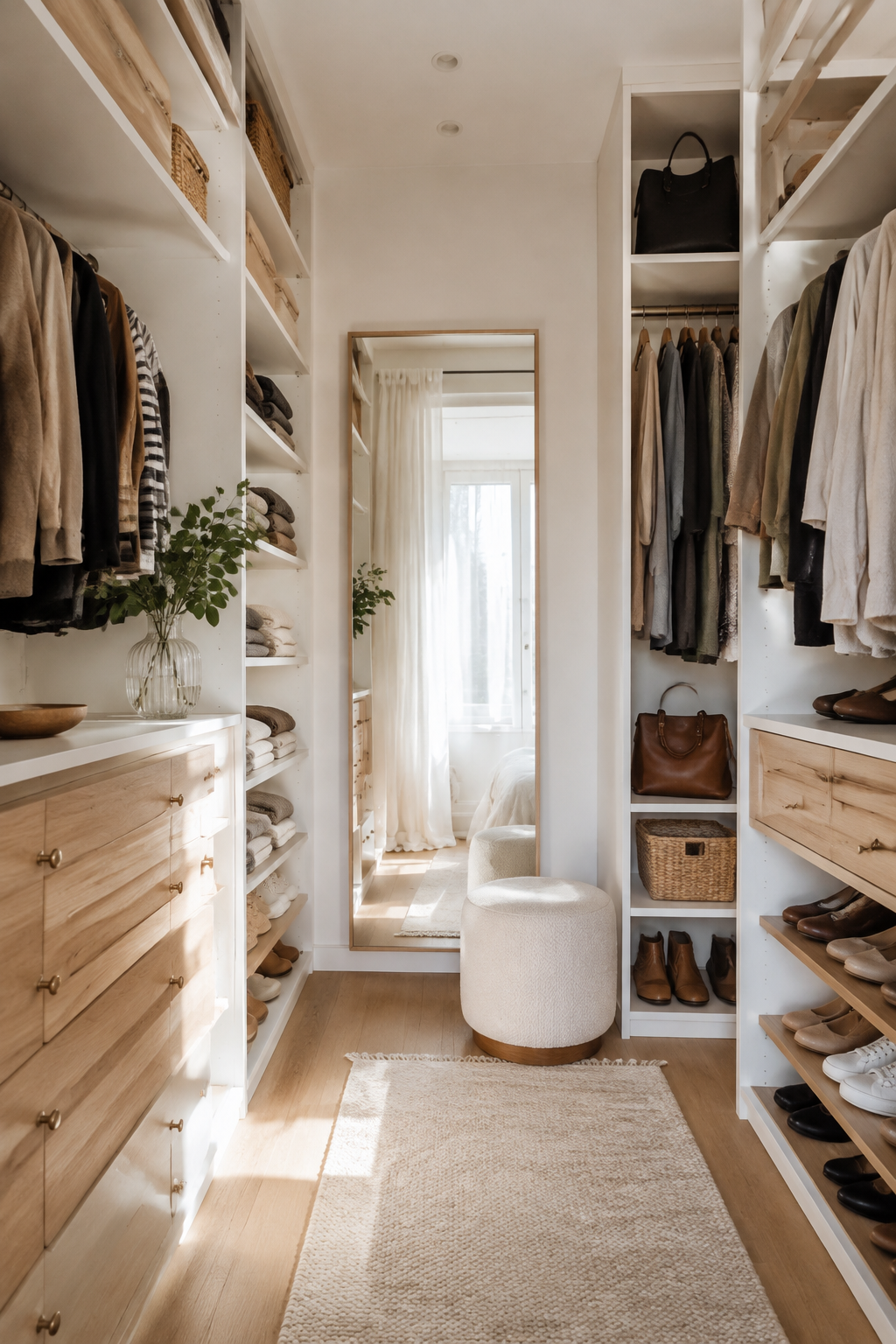
A good wardrobe is not the one with the most compartments. It is the one that lets you see a workable outfit, try it on, make a change and return everything without creating a second wardrobe on the chair. Use this guide for a compact walk-in wardrobe, a converted box room or a reach-in closet with a nearby dressing zone.
THE ROUTE
Design around the dressing journey
Before choosing organizers, follow one ordinary outfit through the room. The storage plan should support four moments rather than divide the space into decorative categories.
See
Current-season clothes and everyday shoes are visible without moving a box.
Select
Pieces that work together sit within one turn or a few steps of each other.
Try
A mirror, clear floor area and one small surface allow quick outfit changes.
Return
Clean, re-wear, laundry and repair items each have an obvious next home.
If a chair currently holds tomorrow’s outfit, lightly worn clothes and returns, the wardrobe is missing transition space—not necessarily more total storage.
THE HEIGHT MAP
Give prime space to the weekly wardrobe
Use body height and frequency—not symmetry—to decide what goes where. Exact reach varies, so test the proposed heights with the shortest regular user before fixing shelves or rails.
Occasional and light
Off-season bags, spare bedding and occasionwear in labeled, lidded storage. Avoid heavy boxes overhead.
Current and frequent
Everyday hanging, folded basics, accessories and the active shoe rotation—from roughly shoulder height down to mid-thigh.
Stable and washable
Shoes, laundry sorters and sturdy pull-out bins. Keep the floor edge clear enough to vacuum.
Plan from the contents outward: measure the longest hanging garments, tallest shoes and deepest folded stack before selecting fittings.
THE FLOOR PLAN
Choose the layout that protects movement
Single-wall run
Keep all full-depth storage on one side and use the opposite wall for a shallow mirror, hooks or a slim ledge.
Watch for:Adding furniture that narrows the route or blocks drawers.
Galley wardrobe
Use two parallel runs when doors and drawers can open without colliding. Put daily categories opposite their natural partner.
Watch for:Deep units on both sides of a tight room; open shelving can preserve more shoulder space.
L-shaped dressing room
Keep one wall for hanging and one for drawers, shoes and accessories. Leave the final wall visually quiet for the mirror.
Watch for:Corner fittings that look efficient but make clothing hard to reach.
Measure before buying
Record the usable room—not just wall length
- Door swing, switches, sockets and vents
- Skirting boards and any sloping ceiling
- Open depth of every drawer and door
- Clear standing space in front of the mirror
- Longest dress, coat and trouser drop
THE ASSIGNMENT
Match storage to the way each category behaves
| Category | Best home | Why it works | Avoid |
|---|---|---|---|
| Shirts, jackets and dresses | Open hanging rail | Easy to scan; protects crease-prone pieces | Overpacked rails with no hand space |
| Knitwear and denim | Shallow folded stacks or drawers | Supports weight and keeps shapes stable | Tall piles that collapse from the middle |
| Underwear and small accessories | Divided shallow drawers | One layer stays visible | Deep mixed bins |
| Everyday shoes | Low open shelf or clear front-opening box | Pairs stay together and easy to identify | Sealed storage for damp shoes |
| Bags | Upright shelf with dividers | Prevents slumping and strap tangles | Hanging heavy bags from delicate handles |
| Occasionwear | Protected upper or end zone | Prime space remains available for weekly clothes | Opaque storage with no label |
A different kind of edit
Create a seven-day working rail
Rather than reorganizing the whole wardrobe each week, reserve a short section for pieces likely to be worn over the next seven days. Add the jacket, shoes or bag that completes each outfit nearby. This reduces searching while revealing what the core wardrobe is missing.
THE OVERLOOKED LOOP
Plan what happens after clothes come off
Clean and ready
Return straight to its assigned rail, drawer or shelf.
Wear again
Use two or three ventilated hooks or a short rail—small capacity forces a decision.
Laundry
Sort only in ways that match the household’s real wash routine.
Repair or leave
Keep one dated bag for tailoring, dry cleaning, donation or resale.
Lighting and mirrors are part of the system
Use even, neutral-looking light that lets colors read accurately. A full-length mirror needs enough clear floor space to step back; placing it where daylight falls across the person, rather than directly behind them, usually gives a more useful view. Battery lights can improve a dark shelf, but they are task lights—not a substitute for safe, properly installed room lighting.
TRY BEFORE A REFIT
Three products that can test the plan
These are practical, small-scale trials for specific wardrobe problems. Product availability and specifications can change, so check the current Amazon listing and your measurements before ordering.
Amazon Basics slim velvet hangers
A narrow profile can create breathing room on a rail, while the velvet surface helps slippery tops stay in place.
Limitation: Velvet can catch delicate fabrics, and a complete hanger change is unnecessary if the rail is already comfortable.
View on Amazon ↗Clear acrylic shelf dividers
Useful for keeping bags upright or separating short folded stacks without committing to new cabinetry.
Limitation: Clip-on dividers require compatible shelf thickness and clearance; measure both first.
View on Amazon ↗SEE SPRING clear shoe boxes
Front-opening boxes can make stacked shoes easier to identify and access than lifting several lids.
Limitation: Check internal dimensions for larger footwear, and let damp shoes dry fully before enclosed storage.
View on Amazon ↗As an Amazon Associate, The Smart Life Edit earns from qualifying purchases. Recommendations are selected for the storage problem they may solve, not because every wardrobe needs them.
QUICK ANSWERS
Walk-in wardrobe questions
How much hanging space should a wardrobe have?
Start with the garments you genuinely hang and measure their combined rail width. Allow room to slide hangers rather than filling every inch, then give the remaining space to drawers or shelves based on what you fold.
Should clothes be organized by type or color?
Type and use usually make dressing faster; color can then help within a larger category. If you build outfits as capsules, grouping by routine—work, casual or exercise—may be more useful than either.
How do I make a small walk-in wardrobe feel less cramped?
Protect a clear route, avoid deep storage on every wall, use consistent hanger heights and keep one wall relatively quiet. Good lighting and a correctly placed mirror help more than filling every gap.
What should stay outside the wardrobe?
Anything unrelated to dressing that displaces frequently worn clothes. Bulky household linens, archives and general storage usually belong elsewhere unless the wardrobe has genuine spare capacity.