
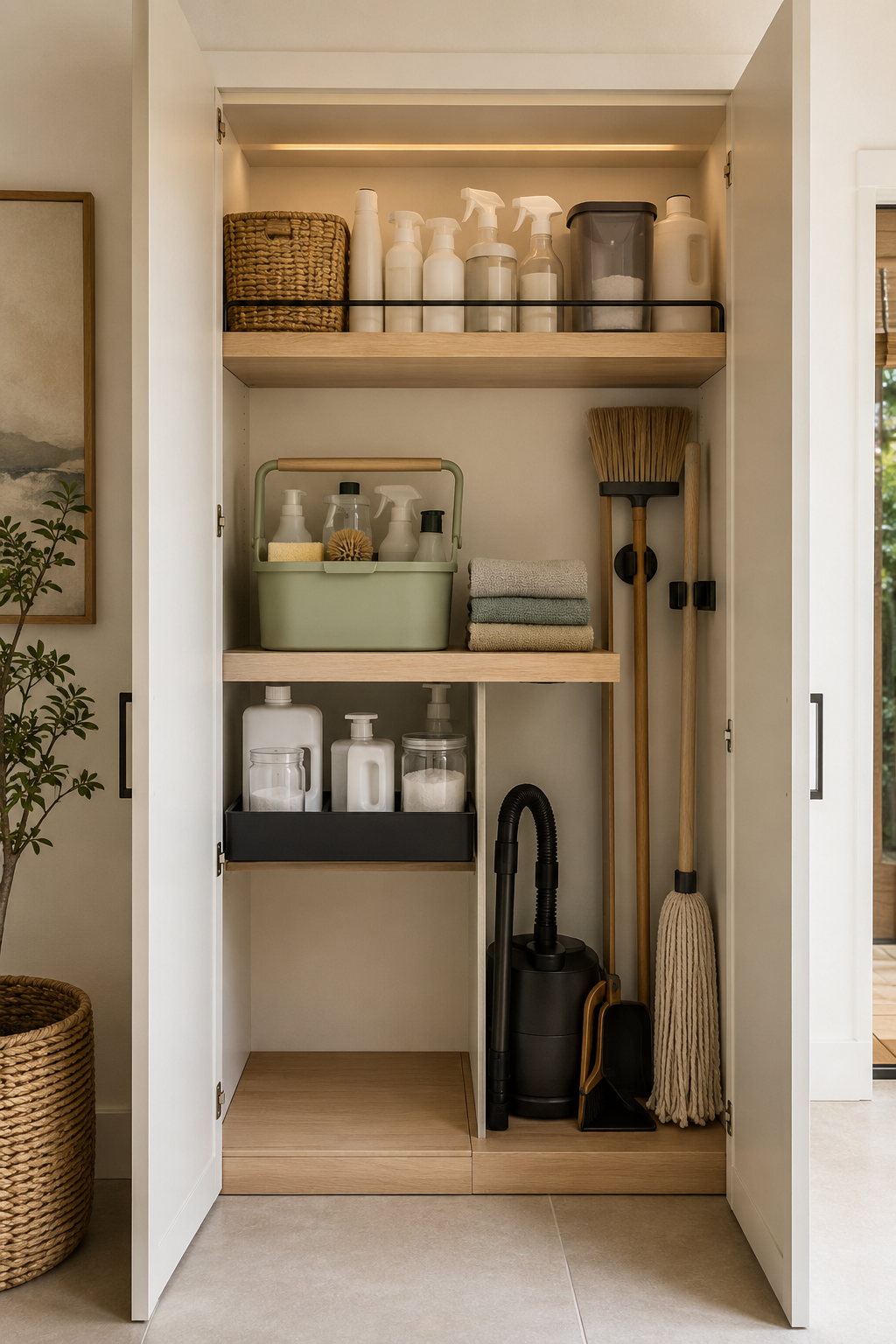
A cleaning cupboard should make the correct product easy to find without making every bottle equally accessible. The useful organizing question is not “Which matching bins should I buy?” It is “Who can reach this shelf, what belongs together for a task, and what must remain secure, upright and identifiable?”
By The Smart Life Edit — product guidance uses current manufacturer specifications and retailer details. No hands-on testing is claimed unless stated. Always follow each product label and the storage instructions supplied by its manufacturer. Read our editorial standards →
THE ACCESS AUDIT
Start with people, products and the cupboard itself
Who can open it?
Account for children, pets, guests and anyone who may confuse similar containers. A latch or locked location can matter more than a beautifully divided shelf.
What needs controlled storage?
Read labels for storage, ventilation, temperature and incompatibility guidance. Keep products in their original labeled containers and do not mix products unless the label expressly directs it.
What can the space tolerate?
Check shelf stability, plumbing, damp, heat, electrical outlets and door clearance. Use a washable tray where a small leak could damage cabinetry.
What actually leaves weekly?
Place frequent, appropriate supplies where an adult user can retrieve the whole task set. Reserve awkward or controlled positions for occasional stock, not daily essentials.
“High shelf” is not a universal safety system: climbing children, open shelving and unstable stools change the risk. Use suitable secure storage for your household and follow label directions.
FOUR REACH ZONES
Give every height a specific job
Occasional and restricted products
Use a secure, stable area for products that should not sit in casual reach, provided this matches their labels and household safety needs. Keep heavy containers low enough for safe adult handling.
Do not rely on decanting or decorative bottles; the original label carries essential instructions.Task caddies and everyday cloths
Store the caddy or small group used most often where it can be lifted without moving unrelated stock. Let the front edge remain visible rather than stacking a second row in front.
Only place products here when access is appropriate for everyone who can open the cupboard.Buckets, refills and washable trays
Put stable heavy items lower down, away from plumbing valves and vulnerable cabinetry. A contained base makes drips visible and easier to clean.
Under-sink space is irregular; measure around pipes, hinges and disposal units before choosing a pull-out.Long, light tools
Clips or narrow holders can lift brooms, dusters and compatible handled tools from the floor when the mounting surface and product capacity suit the load.
Check handle diameter, adhesive surface requirements and door swing before installation.CUPBOARD PROFILES
Work with the storage you actually have
The vertical cleaning station
- Best use
- Long tools on one side, controlled products above, task caddies at adult reach and buckets at the base.
- Measure
- Clear handle height, shelf depth, door swing and the width left after a vacuum or mop is parked.
- Avoid
- Filling every tool into one interlocked bundle that must be removed to reach the cupboard floor.
The plumbing-shaped cupboard
- Best use
- A shallow active caddy and a removable tray arranged around pipes, with products stored only where instructions and household access make the location suitable.
- Measure
- Usable width on each side of plumbing, hinge intrusion, opening height and pull-out depth.
- Avoid
- Buying a full-width organizer before mapping pipes, valves, filters and disposal equipment.
The mixed utility cabinet
- Best use
- Separate household cleaning, laundry treatment and outdoor supplies into clearly bounded groups.
- Measure
- Temperature, damp exposure, shelf loading and the route from the cabinet to each task.
- Avoid
- Treating a hot, freezing or humid garage as neutral storage when a product label specifies otherwise.
TASK CADDIES
Group by the job, not by bottle color
A task caddy earns its space when it removes repeated cupboard visits. It should contain the small, appropriate set needed for one routine—not a portable version of the entire cupboard.
Food-area surfaces
Keep only products and cloths suitable for the surfaces you clean. Store specialist oven or descaling products separately if they are occasional or require different handling.
Sink, shower and toilet tasks
Separate cloths or tools by task, and use a washable caddy that can return dry. Do not combine products or improvise mixtures.
Small tools plus the correct product
Pair the appropriate floor-care supply with pads or accessories, while long handles remain parked vertically nearby.
Lightweight quick-use kit
A compact caddy can hold cloths, a duster attachment and the product specified for the surface. Retire damaged bottles and saturated cloths promptly.
PRODUCT INTEGRITY
Keep the information attached to the product
Keep household cleaning products in their original labeled containers unless the manufacturer specifically provides different instructions. The label identifies contents and carries use, first-aid, hazard and storage information.
Face labels forward
Arrange a shallow row or use a pull-out that lets an adult user identify the bottle before lifting it. Do not hide leaking or damaged packaging behind a label on a secondary bin.
Contain without compressing
Use a washable tray or caddy to catch small drips, but allow bottles to stand securely with closures accessible. Do not force trigger sprayers under a low shelf.
Follow compatibility instructions
Keep products apart when their labels or manufacturer guidance require it. Never assume products can share a container or be combined because they are used in the same room.
THE ONE-PLUS-ONE RULE
Control backstock before it hides the active bottle
Simple reserve boundary
One active product, one planned reserve
For a genuine repeat-use product, keep the open bottle in the task zone and at most one reserve in a clearly separate backstock position. Adjust the boundary for purchasing frequency, household size and label storage requirements.
Add the product to a shopping list rather than opening the reserve early.
Move the reserve forward and check the packaging for correct disposal guidance.
Buy against the list, not the visual impression that the cupboard looks sparse.
Review damaged, expired or unwanted products and use local disposal guidance; do not pour products together.
FAILURE DIAGNOSTIC
Let recurring mess identify the design fault
Bottles collect on the floor
Likely fault: shelf height or task grouping makes replacement harder than dropping the bottle.
Change: create one lift-out task home at the easiest suitable adult reach.
The caddy returns wet
Likely fault: cloths, brushes or bottles have no drying pause.
Change: define a ventilated drying point and return the caddy only when it is suitable to store.
Refills block active products
Likely fault: reserve stock has no boundary.
Change: separate active and reserve zones and cap duplicates intentionally.
Handles fall across the doorway
Likely fault: tools are leaning rather than individually supported.
Change: use correctly rated clips, a stable rack or a partition that releases one handle at a time.
TARGETED PRODUCTS
Choose an organizer only for a known constraint
Command Broom Gripper
The adhesive gripper is designed to hold one broom or mop handle on compatible smooth surfaces, with a listed capacity of up to 4 pounds.
Limitation: Capacity, handle fit and surface preparation matter. It is not suitable for every wall finish, rough surface or heavy tool, and adhesive products should be installed exactly as directed.
View on Amazon ↗Casabella Cleaning Storage Caddy
The handled plastic caddy is listed at roughly 15.25 × 10.25 × 5.25 inches with a 1.85-gallon capacity, giving bottles, cloths and small brushes a washable portable boundary.
Limitation: It needs an uninterrupted shelf footprint and can become heavy if treated as whole-cupboard storage. Measure bottle and shelf height before choosing it.
View on Amazon ↗YouCopia RollOut Under Sink Caddy, 8-inch
The narrow pull-out is listed at approximately 7.7 inches wide, 16.4 inches deep and 5.3 inches high, with an extendable basket, adjustable dividers and a stated 30-pound capacity.
Limitation: Extended depth is approximately 21.3 inches. Pipes, hinges and door openings may prevent full travel, and a pull-out does not make an under-sink location appropriate for every product or household.
View on Amazon ↗As an Amazon Associate, The Smart Life Edit earns from qualifying purchases. Recommendations are selected for a specific access problem, not because every cupboard needs additional storage.
THE AFTER-USE RETURN
Close the routine safely, not just quickly
Before the cupboard closes
Dry, check, identify and return
Dispose of waste as directed, allow suitable reusable tools to dry, wipe the caddy, confirm closures, inspect for leaks and return each original labeled container to its appropriate secure zone.
Secure products, close lids and move damp tools to their defined drying point.
Return cloths and brushes without trapping moisture inside a closed caddy.
Wipe the base tray, check active quantities and clear anything parked outside its zone.
Review access needs, damaged packaging, duplicate stock and products no longer used.
QUICK ANSWERS
Cleaning cupboard organization questions
How should I organize a small cleaning cupboard?
Prioritize a secure product zone, one compact task caddy, a contained base and individual support for long handles. Remove reserve stock that exceeds the cupboard’s planned capacity.
Is under the sink a good place for cleaning products?
It depends on the product label, household access, plumbing, heat, damp and available secure storage. Do not assume the location is suitable simply because it is traditional.
Should cleaning products be decanted into matching bottles?
Keep them in their original labeled containers unless the manufacturer explicitly directs otherwise. Decorative decanting can remove essential identification, hazard and use information.
How do I stop brooms and mops falling over?
Support handles individually with correctly rated clips, a stable floor rack or a divided tall zone. Check diameter, weight, mounting surface and door clearance first.
How much cleaning-product backstock should I keep?
Use a deliberate boundary based on consumption and shopping frequency. One active item plus one reserve is a useful starting point for true repeat products, provided storage instructions are met.